

Cuckmere Pilgrim Path
Southeast England & London


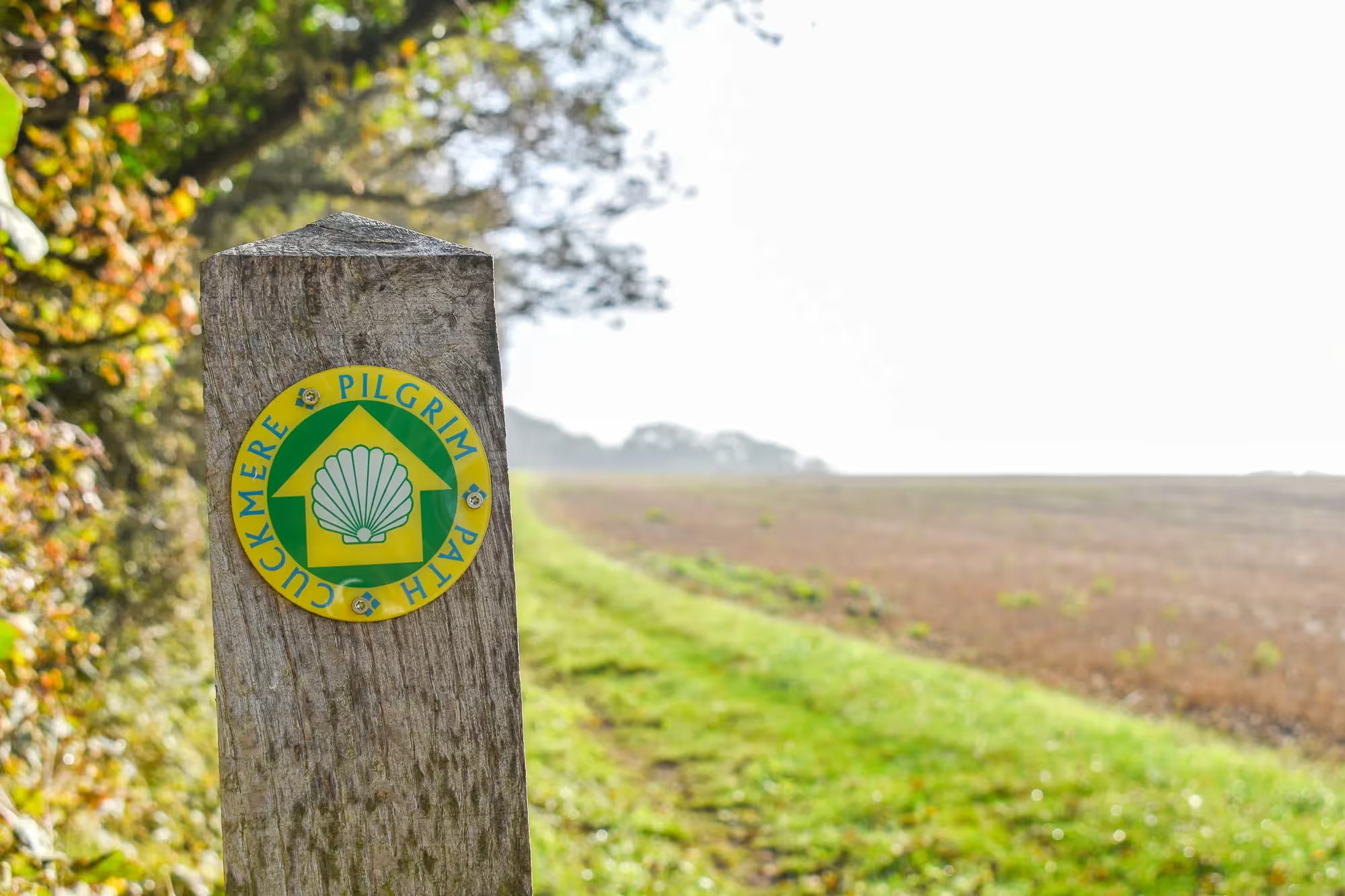


Cuckmere Pilgrim Path – 12 miles, 1 day
Alfriston-Berwick-Alciston-Selmeston-Arlington-Wilmington-Lullington-Alfriston (circular)
This route touches many points on a short section of our flagship route, Old Way from Southampton to Canterbury. Due to its circular 1-day nature and being a particularly beautiful and special part of the Old Way, we heartily recommend the Cuckmere Pilgrim Path, which is well-waymarked and well-crafted.
See the official Cuckmere Pilgrim Path website.
The article below was first published in the Idler Magazine
There is a particular practicality in a circular pilgrimage. The other beauty is that you are not going anywhere, exactly. You set off from a church door and, some hours later, arrive back at the same church door. And yet you won’t be the same person who set out that morning.
The Cuckmere Pilgrim Path is twelve or so miles, which is not nothing in a day, so perhaps be generous to yourself and give it two. It loops around the Cuckmere valley between Lewes and Eastbourne, taking in seven ancient country churches and it was strung together in 2018 by the local benefice out of footpaths that were already there – practical and simple. There is a love in each of the churches, who welcome pilgrims in heart-centred ways, such as sweet touches like pilgrim pebble cairns with messages.
Assuming you are arriving by car, doing the whole thing in one day and staying overnight in Alfriston, you begin at St Andrew's, Alfriston, which sits on a green mound in the heart of the village. (Otherwise your first walking stop from Berwick train station will be Arlington) They call Alfriston’s church the Cathedral of the Downs, and standing under its flint walls with the Downs behind, you can see why. The Star Inn has been putting pilgrims up since 1345, when it was a hostel for travellers heading to St Richard's shrine at Chichester (it is now part of the Olga Polizzi hotel collection, for those desiring the finer things), and next to the church stands the thatched Clergy House, which in 1896 became the first building the National Trust ever bought, for ten pounds…
Walk away clockwise around the route and within twenty minutes you are climbing just far enough to look back down on Alfriston laid out whole in its valley, a familiar pleasure of a pilgrim. Then Berwick, where the church is next to another mound, possibly a burial barrow, possibly a Saxon meeting place, and where a colourful surprise waits inside. In 1941, with the country at war, Bishop George Bell of Chichester invited Duncan Grant, Vanessa Bell and Quentin Bell (of the Bloomsbury group associated with nearby Charleston Manor) to paint the interior. They did the whole thing: Christ in Glory, the Nativity, the Annunciation, all set in the Sussex hills, with local farmhands and airmen and shepherds standing in for the holy cast, in the manner of the arts and crafts movement. They also painted spring, summer, autumn and winter in roundels to go in parallel with baptism, confirmation, marriage and last rites roundels on the rood screen. Locals have also installed a jukebox playing appropriate music to accompany looking at the different painted scenes. Bishop Bell hoped the art would start a fashion. It didn't, sadly, which makes Berwick all the more worthwhile to dwell in. You will probably never have seen anything like it.
On to Alciston, a single street of a village with a vast ruined tithe barn, a medieval dovecote, and the Rose Cottage Inn. Then Selmeston, where archaeologists once dug up the flint-strewn floor of a Mesolithic camp – people were living well here several thousand years before churches were built. Cross the Cuckmere and turn north-east for Arlington, whose church of St Pancras has Saxon stonework in its walls and a nearby reservoir full of geese.
Then Wilmington, and the last blockbuster stretch. The church of St Mary and St Peter is guarded by a yew that some put at 1,600 years old; it is enormous, hollow, and held together with props and chains like a grand elder. Its accompanying church has a sweet energy inside. Beside it stand the ruins of a Benedictine priory. Above it, cut into the chalk, the Long Man of Wilmington holds his two portal-like pilgrim staffs, falling into shadow between Samhain (All Souls’) and Beltane (May Day).
Here the path offers a choice. You can take the high option, up onto the Downs above the Long Man for the long view, then drop down to Lullington. Or you can take the gentle path back via Milton Street, which is level and pretty with no climbing.
Take the high one if your legs allow, because Lullington is the jewel and you probably want to spend some time high up the Downs (although you could do Lullington on the lower path too as a detour). The Church of the Good Shepherd is 256 square feet and seats twenty at a squeeze. It is only the chancel of a larger church that burned, probably in Cromwell's time, and the parish simply carried on using the bit that was left. You reach it up a winding path, hidden behind trees, and it is almost always empty.
Then Alfriston again, and tea and perhaps a luxurious hotel stay or a more ‘pilgrim’ Sanctuary stay.
The practical bit: Berwick station is on the Lewes–Eastbourne line, a short walk from the route, so you can do the whole thing without a car: get off, walk round, get back on. Twelve miles is a full but comfortable day. Splitting it over two is better, and lets you linger in Berwick and Lullington, overnighting in Alfriston.
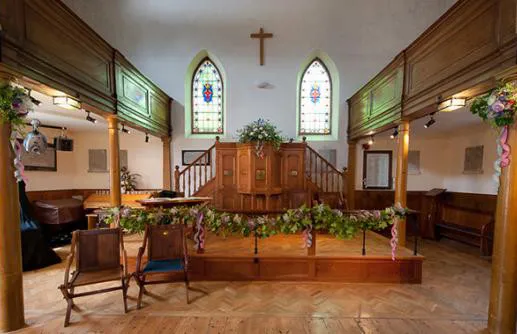
Alfriston's Old Chapel Centre offers sanctuary accommodation to pilgrims at very low cost – a roof, a floor, warmth and a kettle, with your own sleeping bag and mat. It is booked ahead through oldchapelcentre.com, and it is exactly the sort of arrangement that used to be ordinary and is now radical: somewhere to sleep for almost nothing, offered because you are walking and call yourself a pilgrim. Sleep there and the whole circle costs you a train fare and your lunch.
Go and spend a day going in a circle in the last Anglo-Saxon region to be Christianised, a druidic landscape now bejewelled with beautiful churches.
Route highlights


Location

Nearby Places
Nearby Sanctuaries


Discover holy places, and bring your own beliefs.
Pilgrimage by foot is connected with places and landscape, and how those places make you feel. Read about holy places.
At the British Pilgrimage Trust, we believe a pilgrimage should be made on an individual’s own terms. We are founded on the principle that we can all bring our own beliefs to the journey, accessible and welcoming to all.


Comments
0 Comments
Login or register to join the conversation.
Tom Jones
Lorem ipsum dolor sit amet, consectetur adipiscing elit. Suspendisse varius enim in eros elementum tristique. Duis cursus, mi quis viverra ornare, eros dolor interdum nulla, ut commodo diam libero vitae erat. Aenean faucibus nibh et justo cursus id rutrum lorem imperdiet. Nunc ut sem vitae risus tristique posuere.