

South Dorset Old Stones Way
Southwest England




South Dorset Old Stones Way – 10 miles, 1 day
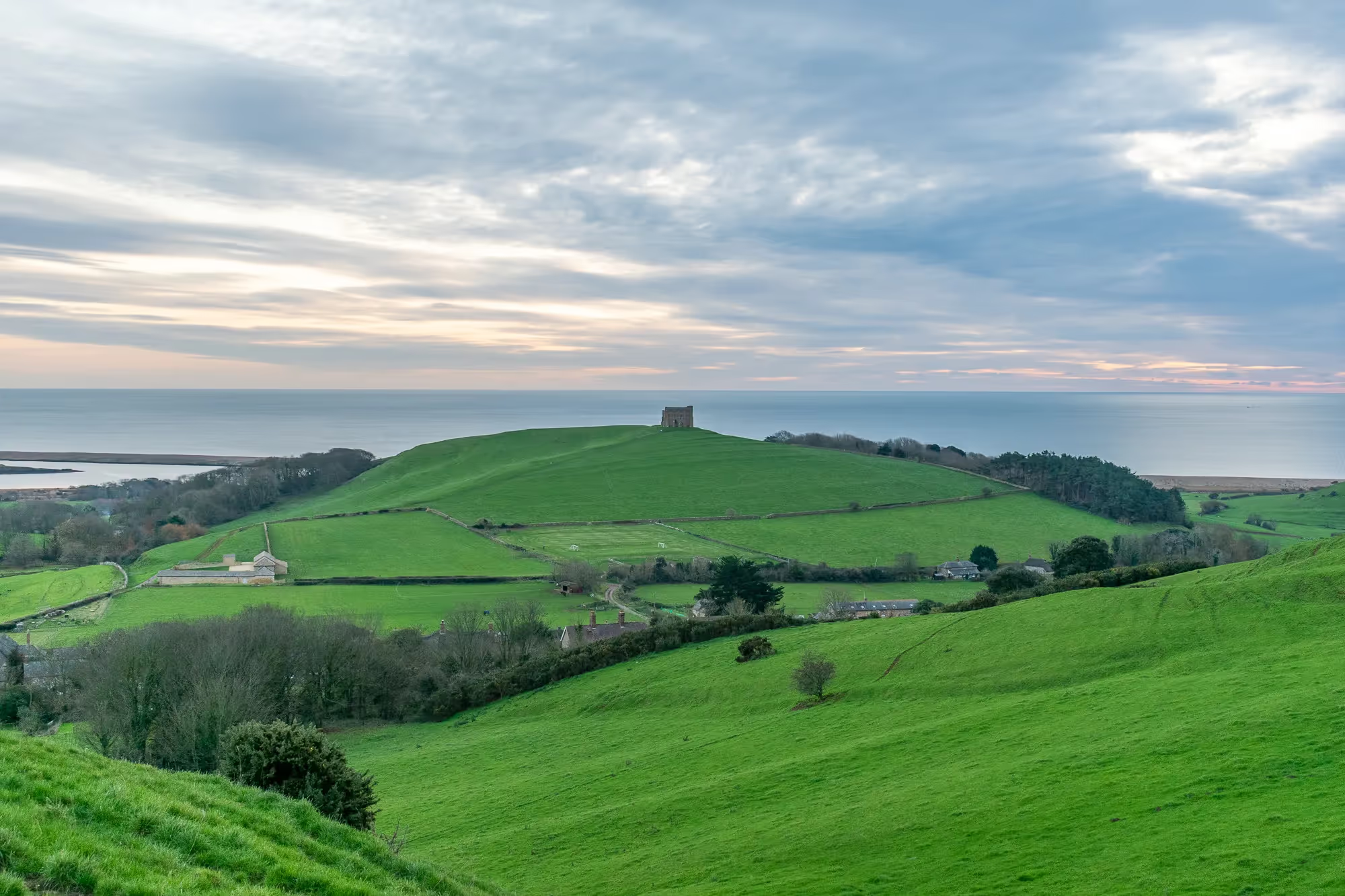
Make pilgrimage through South Dorset’s historic landscape, which has an unusually high concentration of prehistoric sites. From the start at St Michael and All Angels Littlebredy Church walk through the ‘Valley of Stones’ towards the ‘Grey Mare and her Colts’ – a long barrow guarded by three great stones – and the Kingston Russell Stone Circle overlooking the coastline a few miles away. Delve down into the woods to find a secret ruined chapel with simply an arch, altar and a few gravestones. Ascend to Abbotsbury Hill Fort, before walking the Ridgeway and descending into the village of Abbotsbury, with the remains of its Abbey and the unforgettable finish at St Catherine’s Chapel-on-the-Hill.
Walking through this remote landscape immerses you in a land before records began.
The Valley of Stones
The Valley of Stones is a National Nature Reserve holding one of the finest sarsen boulder trains in Great Britain. The stones are not placed: at the end of the last ice age, freeze and thaw shattered the sandstone capping the chalk hilltops and the fragments slumped down the slope. There is evidence the valley was worked as an ancient quarry, its stones carried off to build other megalithic sites nearby — which may well mean the ones you are walking towards. The grassland is rich in wildflowers and butterflies, with adonis blues on the south-facing slopes, and medieval field patterns still legible across it.
The Grey Mare and her Colts
A Neolithic chambered tomb of 3400–2400 BC. The mound survives about 24 metres long, tapering from 13 metres wide to 8, and standing roughly a metre high. At its south-eastern end four massive sarsens form a shallow crescent, three still upright; behind them lies a fifth, thought to be the capstone of the collapsed burial chamber. Smaller stones set into the mound's edge are the remains of a kerb. An excavation in the early 19th century found human bone and pottery.
Kingston Russell Stone Circle
Eighteen fallen stones on a hilltop looking down over Abbotsbury and the sea, raised in the late Neolithic or early Bronze Age. Every one is now recumbent. There is no road to it and no car park — you arrive on foot, which is how it should be met.
St Luke's Chapel in the Woods
A 15th-century chapel, Grade II* listed, now a fragment in the trees at Ashley Chase. What stands is the west gable wall with its pointed archway, and a corner of the north-east angle; the building it belonged to was about 32 feet by 18. Slate memorials on the inner face of the gable mark 20th-century burials here.
Abbotsbury Abbey
The abbey was founded in 1044 by a thegn of King Cnut and grew rich; Henry VIII had it pulled down in 1538. What is left is part of a 13th- or 14th-century building that may have been the abbot's lodging, the great tithe barn of around 1400, and two medieval stone coffins in the churchyard of St Nicholas.
Lady Well
Historically dedicated to the Virgin Mary, the feeds a stream flowing southward towards the village. The well is between the main village and is marked on the Google map below.
St Catherine's Chapel
The monks of Abbotsbury built St Catherine's Chapel on its hill in the late 14th century as a pilgrimage chapel, and withdrew to it in Lent — rare for a monastic building set outside the abbey precinct. It is local limestone, heavily buttressed, with a stone vaulted roof and an octagonal stair turret at the north-east corner. The dedication to St Catherine of Alexandria, patron saint of virgins, was unusual; young women came here to ask her help in finding a husband, making their wish at the carved holes in the doorway. It survived the Dissolution most likely because it was useful as a sea mark, with a navigation light burning at the top of the turret.
Getting there and back
The route is linear, so you finish ten miles from your car. Park in Littlebredy and take a taxi back from Abbotsbury at the end — book it before you set off, as it's not a place to find one waiting.
Nearest station: Dorchester.
This route was created by Jason Goodwin, and was developed in collaboration with Guy Hayward of BPT.
Route highlights


Location

Nearby Places
Nearby Sanctuaries



Discover holy places, and bring your own beliefs.
Pilgrimage by foot is connected with places and landscape, and how those places make you feel. Read about holy places.
At the British Pilgrimage Trust, we believe a pilgrimage should be made on an individual’s own terms. We are founded on the principle that we can all bring our own beliefs to the journey, accessible and welcoming to all.


Comments
0 Comments
Login or register to join the conversation.
Tom Jones
Lorem ipsum dolor sit amet, consectetur adipiscing elit. Suspendisse varius enim in eros elementum tristique. Duis cursus, mi quis viverra ornare, eros dolor interdum nulla, ut commodo diam libero vitae erat. Aenean faucibus nibh et justo cursus id rutrum lorem imperdiet. Nunc ut sem vitae risus tristique posuere.