

Aeron River (Afon Aeron) Pilgrimage
Wales


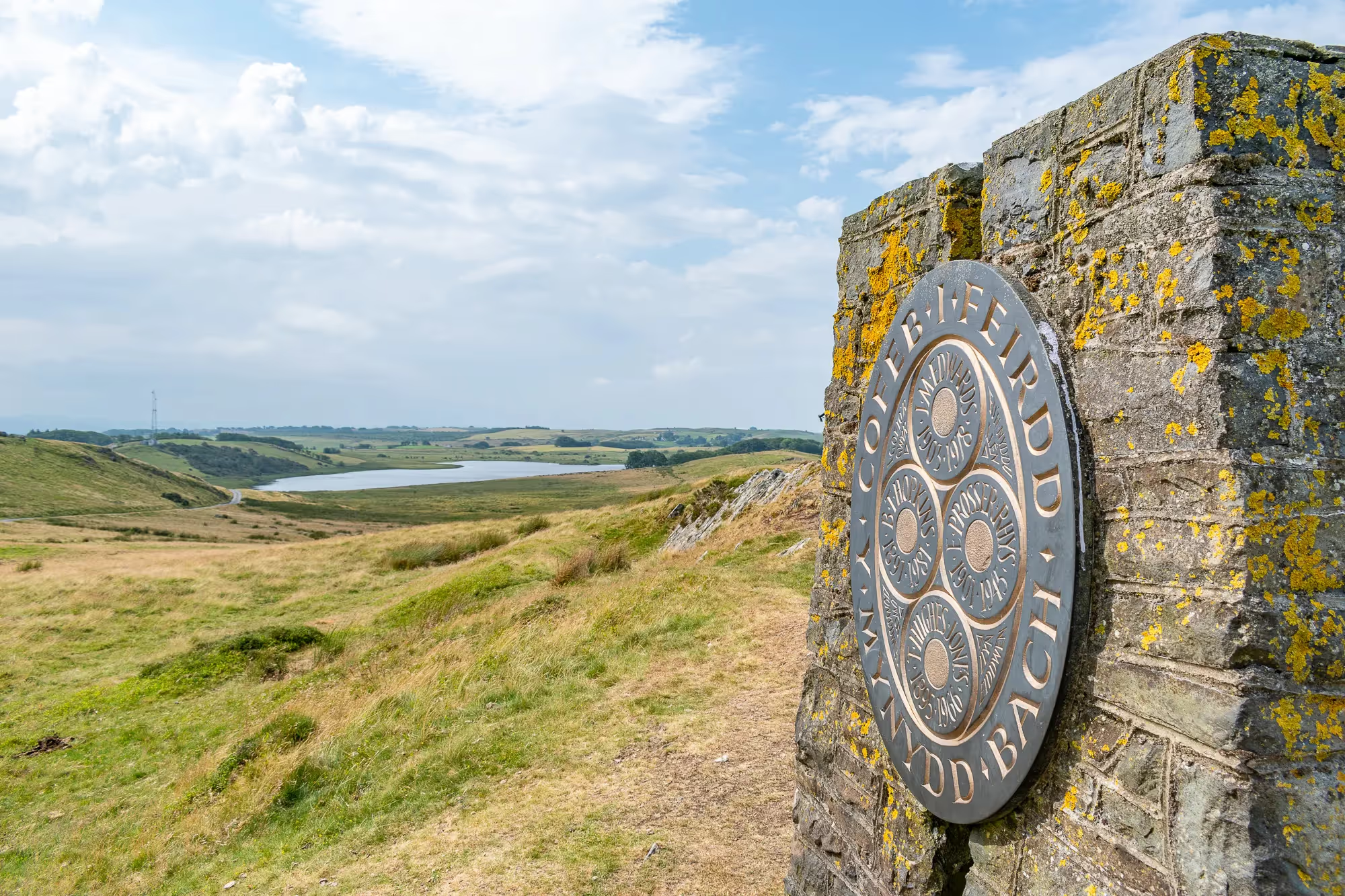


Aeron River Pilgrimage – 24 miles, 2 days
The Afon Aeron is a small river in Ceredigion, west Wales, that rises on the moorland of Mynydd Bach and flows into Cardigan Bay at Aberaeron. Its name carries three meanings. From the Middle Welsh aer comes "battle" or "slaughter" – Aeron is thought to have been a Welsh god of war. In his Dictionary of the Welsh Language, William Owen Pughe translated it as "queen of brightness". And aeron in everyday Welsh simply means berries, fruit, or grain, i.e. harvest.
This source-to-sea journey follows the river through the full arc of its life. A river is a natural metaphor for birth to death: the clear, sparkling spring is like the bright eye of a newborn; tributaries along the way are like the teachers and influences that shape us; and the wide estuary, where the Aeron dissolves into Cardigan Bay, is like the death of the river opening into the oneness of the ocean.
The route takes in the source lake at Llyn Eiddwen National Nature Reserve, the Poets of Mynydd Bach Monument above Trefenter, Bontnewydd Church, the Ffynnon Geitho valley and Nant Cadwyn path, and Llangeitho – the heartland of Daniel Rowland and the 18th-century Welsh Methodist Revival. It passes Capel Betws Lleucu, Bwlchwernen Fawr (Holden Dairy Farm, Wales's oldest organic dairy and a Sustainable Food Trust Beacon Farm, with beds for pilgrims), Llwyn-y-groes and Gartheli churches, Llwyn Madog, Abermeurig, Trefilan Church with its medieval castle mound, and Plas Gelli at Tal-sarn, the wartime home of Dylan Thomas, who called the Aeron valley "the most precious place in the world". It then descends through Blaencamel Organic Farm, the National Trust estate of Llanerchaeron (John Nash's Georgian villa of 1795), Pont Newydd, and Aberaeron's Holy Trinity Church, ending at the harbour and the mouth of the river.
Low-cost accommodation along the route at Cilcennin; Bwlchwernen Fawr, and across region.
The Afon Aeron Story
Written for Idler Magazine, by Guy Hayward
Every river has a name and a story, and is worth walking. The Afon Aeron, which rises at Llyn Eiddwen on the gentle humps of Mynydd Bach and tumbles west to merge with Cardigan Bay at Aberaeron, has several. To some, Aeron was a Welsh god of war, his name drawn from the Middle Welsh aer: battle, slaughter. To William Owen Pughe, the eccentric 18th-century lexicographer, "Aeron" meant "queen of brightness". And aeron in everyday Welsh can simply mean berries. A river of war, light, or harvest. Walked end-to-end, over 24 miles and two days, I hope that only two of those meanings find you.
The Start: Llyn Eiddwen
One begins at Llyn Eiddwen itself, 300 metres above the sea, where the Aeron is born as the clear overspill of an upland lake. Oligotrophic water, low in nutrients and high in mystery: Merlin is said to have prophesied that Carmarthen will sink when this lake dries up, and local tradition once held that blocking its outflow would enrage the fairies beneath it. This is the birthplace of this innocent, clear, sparkling mysterious river.
The Poets of Mynydd Bach Monument stands on a nearby windy ridge overlooking the lake: a simple stone raised to four local bards – Hughes Jones, Hopkins, Edwards and Prosser Rhys – who all competed at the National Eisteddfod from this quiet corner of Wales. One sometimes forgets how densely poetic the Welsh uplands have been. The bards are the first of several poetic presences along the Aeron and, metaphorically, a useful reminder that a river gathers its tributaries along its course in the same way a child gathers its inspiring ‘influences’.
To the Ffynnon Geitho Valley
Descending through Bontnewydd and its plain whitewashed church, the path dips into the Ffynnon Geitho valley and onto the Nant Cadwyn path, arriving at Llangeitho through stiles and fields. Llangeitho is a momentous small village in Wales. From 1735, the curate Daniel Rowland preached here with such conviction that he helped spark the Welsh Methodist Revival, his congregations eventually swelling over a thousand and earning the nickname "Jumpers" for their habit of leaping at his sermons. The Bishop of St David's deprived him of his curacy in 1763; Rowland simply built a new chapel around the corner and carried on. A river, likewise, is not easily talked out of its course and always finds a way round a boulder.
Holden Farm Dairy, Wales' Oldest Certified Organic Dairy Farm
At the end of the first day, and south-west through Capel Betws Lleucu, the route climbs briefly to Bwlchwernen Fawr, home of Holden Farm Dairy, where since 1973 my friend and farming inspiration, Patrick Holden, has tended what is now the oldest certified organic dairy farm in Wales. Eighty Ayrshire cows graze the clover pastures, and in the creamery Hafod is made – a raw-milk cheddar built from a 1917 recipe, today available from Neal’s Yard Dairy as one might hope. The Sustainable Food Trust has designated Bwlchwernen one of its Beacon Farms, and they keep beds for pilgrims. I can report that falling asleep and waking up to the distant sound of ruminating cattle beats any meditation app for feeling rooted in place.
Dropping back to the water, past Llwyn-y-groes, Gartheli and Llwyn Madog, the Aeron broadens into its true valley. At Abermeurig another stream joins; at Trefilan a grass-covered motte rises beside the parish church – Castell Trefilan, raised by Maelgwyn ap Rhys and completed by his son Maelgwyn Fychan around 1233. In 1282 Edward I's men found three thousand cattle penned there and burned "the house" to the ground. Cross the bridge and you reach Plas Gelli, the creeper-hung Jacobean farmhouse just outside Tal-sarn, where Dylan and Caitlin Thomas lived intermittently between 1941 and 1944. He wrote beneath an apple tree in the garden. He called the Aeron valley "the most precious place in the world". Their daughter, born soon after, was named Aeronwy. Tal-sarn itself was once a nest of beirdd y wlad, country poets – John Davies the cobbler-bookbinder, Joseph Jenkins who later wrote the Diary of a Welsh Swagman in Australia.
By the time the river reaches Blaencamel Organic Farm – Peter Segger and Anne Evans's pioneering organic market garden with its necessary polytunnels – the Aeron has gathered volume, breadth and a certain purposefulness. At Llanerchaeron it flows past a beautiful church and the Georgian villa John Nash designed in 1795, in his obscure early years in Wales, before he became the man who built Buckingham Palace and the Brighton Pavilion. Then Pont Newydd, then the squat tower of Aberaeron's Holy Trinity Church, and suddenly you are among the painted terraces of Alban Gwynne's harbour town, a Regency grid conceived in 1807, each house a different colour.
The Aeron Meets Cardigan Bay
At the mouth, where the Aeron meets the open water of Cardigan Bay, sit down on the stones, cleanse yourself in the saltwater, and watch a river die as well as meet something bigger, only to evaporate and become rain and fall somewhere else, perhaps like us ourselves as we meet our ‘end’. A river has been born, educated, made useful, made beautiful, and now dissolves into something larger than itself.
Route highlights


Location


Nearby Sanctuaries


Discover holy places, and bring your own beliefs.
Pilgrimage by foot is connected with places and landscape, and how those places make you feel. Read about holy places.
At the British Pilgrimage Trust, we believe a pilgrimage should be made on an individual’s own terms. We are founded on the principle that we can all bring our own beliefs to the journey, accessible and welcoming to all.


Comments
0 Comments
Login or register to join the conversation.
Tom Jones
Lorem ipsum dolor sit amet, consectetur adipiscing elit. Suspendisse varius enim in eros elementum tristique. Duis cursus, mi quis viverra ornare, eros dolor interdum nulla, ut commodo diam libero vitae erat. Aenean faucibus nibh et justo cursus id rutrum lorem imperdiet. Nunc ut sem vitae risus tristique posuere.